
Most articles about WhatsApp Business API pricing are written for an American reader and quote US dollars. That is not much use if you run a business in Kuala Lumpur, bill in ringgit, and want to know what next month’s Meta invoice will actually look like.
This breakdown is Malaysia-specific. It covers what Meta charges per message in MYR, what is genuinely free, three worked examples at real volumes, and six legitimate ways to bring the number down.The short answer
There is no licence fee for the WhatsApp Business API. Meta charges you per message delivered, and only for template messages. Your replies inside an open conversation are free.Your total monthly cost has two separate parts, and businesses routinely confuse them: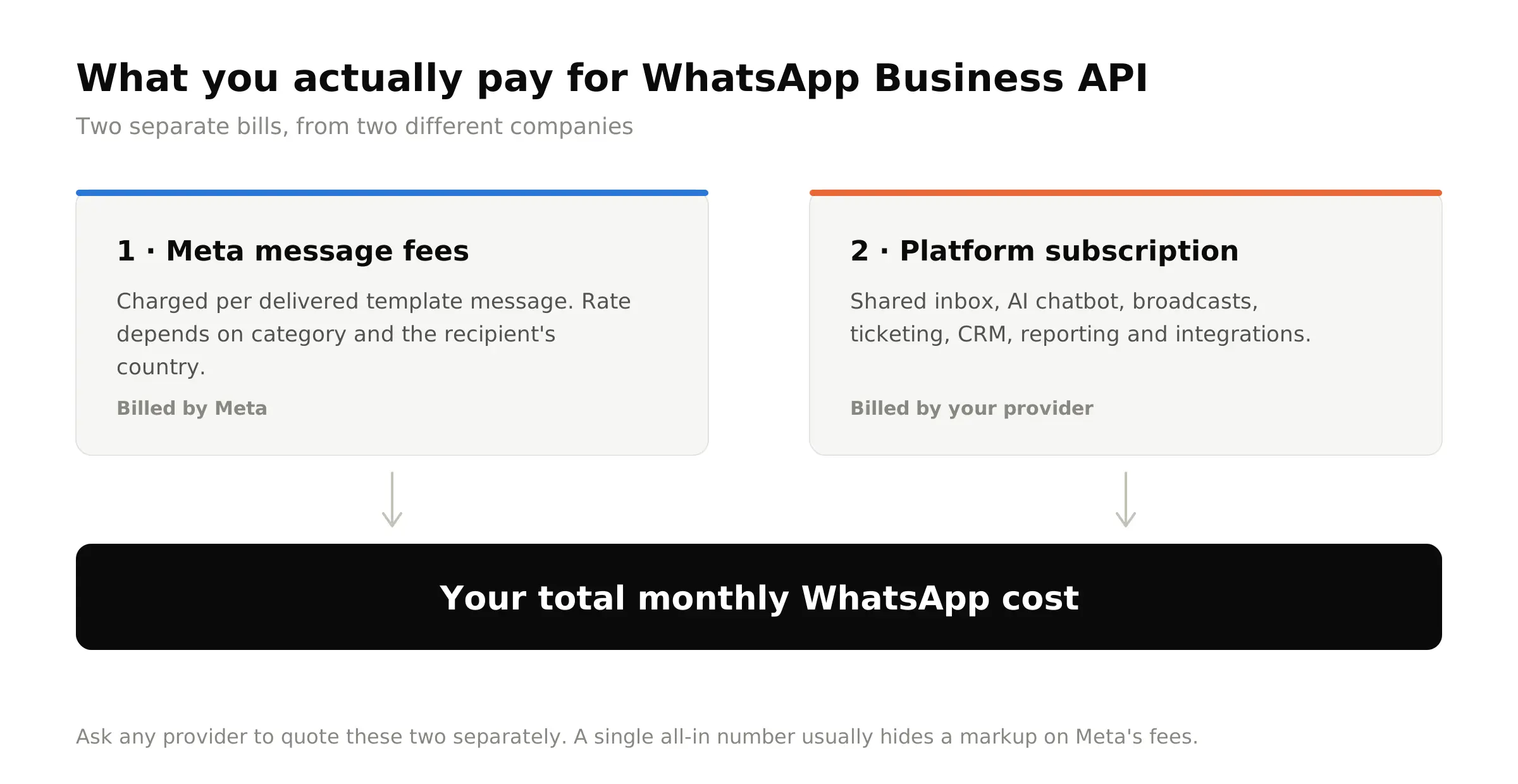
Malaysia now bills in ringgit
One change that affects every Malaysian business: since 1 April 2026, MYR is one of Meta’s billing currencies for the WhatsApp Business Platform. Before that, Malaysian businesses were billed in USD and absorbed the exchange rate movement on top of the message cost.The four message categories
Everything you send falls into one of four buckets, and the price gap between them is enormous.Any time, to opted-in contacts, using an approved template.
Any time, tied to a specific transaction or account, using an approved template.
Any time, using an approved template.
Only within the 24-hour customer service window.
Malaysia rate card
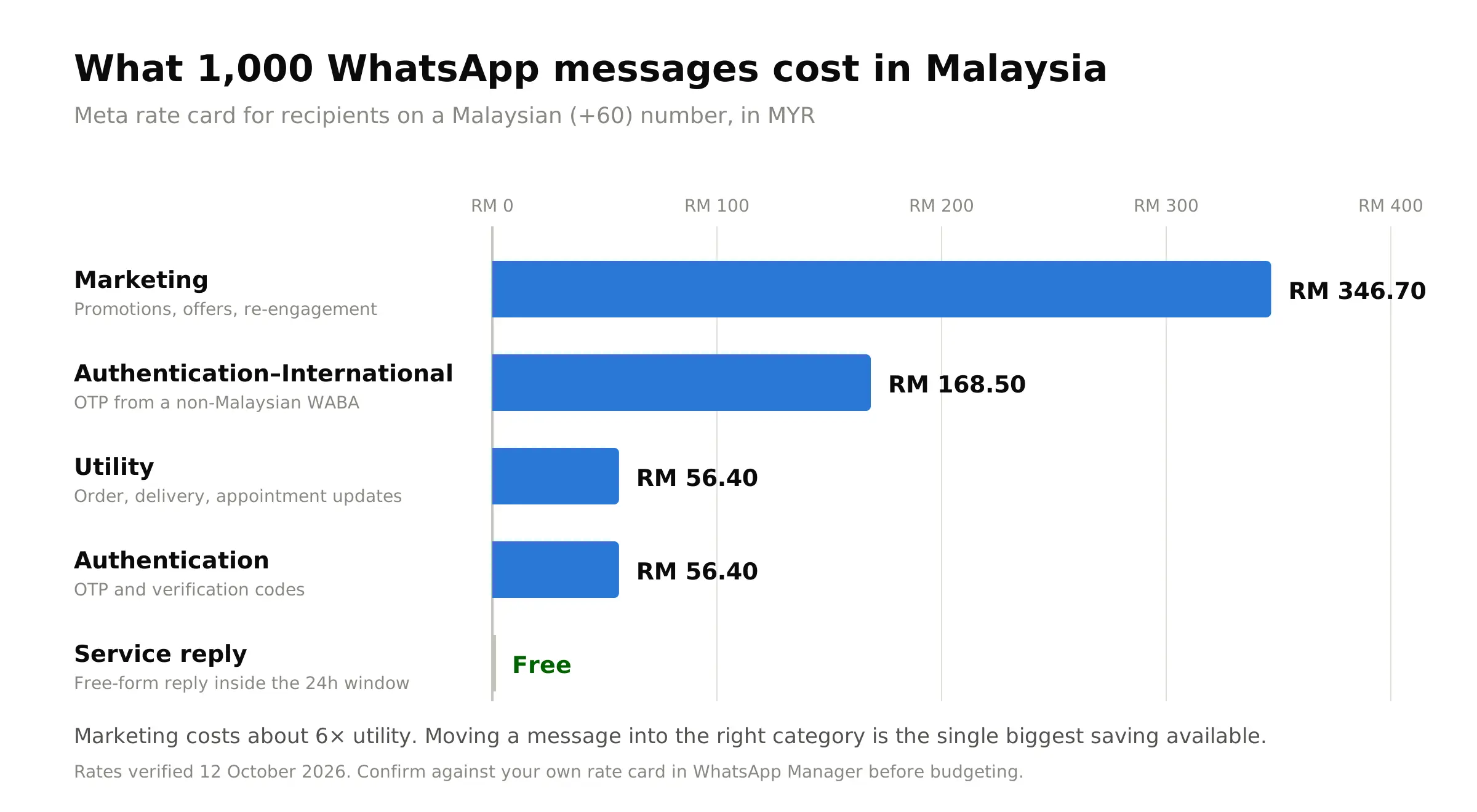
These are the per-message rates for recipients with a Malaysian (+60) number, from Meta’s MYR rate card.| Message category | Rate per message (MYR) | Notes |
|---|---|---|
| Marketing | RM 0.3467 | Highest cost No volume discount at any tier |
| Utility | RM 0.0564 | Volume discounts apply at higher monthly tiers |
| Authentication | RM 0.0564 | Volume discounts apply |
| Authentication–International | RM 0.1685 | Applies when the OTP is sent from a WhatsApp account registered outside Malaysia |
| Service (free-form replies in an open window) | Free | Free Per Meta’s current published documentation |
Two things worth knowing about how these rates move
A note on the service message question
Through 2026, a number of provider blogs have reported that from 1 October 2026 Meta would begin charging for service messages beyond an allowance of 1,000 per business phone number per month, and would begin charging for utility templates sent inside an open customer service window.As of 12 October 2026, Meta’s own published pricing documentation does not describe either change. It states that non-template messages are free, and that utility templates delivered within an open customer service window are free, with no monthly cap attached to either. The only changes Meta lists for 1 October 2026 are rate-card movements in nine specific markets — Bangladesh, Iraq, Nepal, Sri Lanka, Kazakhstan, Kuwait, Morocco, Oman and Ukraine. Malaysia is not among them.We are flagging this because the claim is widespread and businesses have been quoted budgets based on it. If you have been told your support replies are now billable, check your own Meta billing statement before accepting it. And because this is exactly the kind of rule that can change on a future quarter boundary, check the date at the top of any pricing article you read, including this one.
Three worked examples
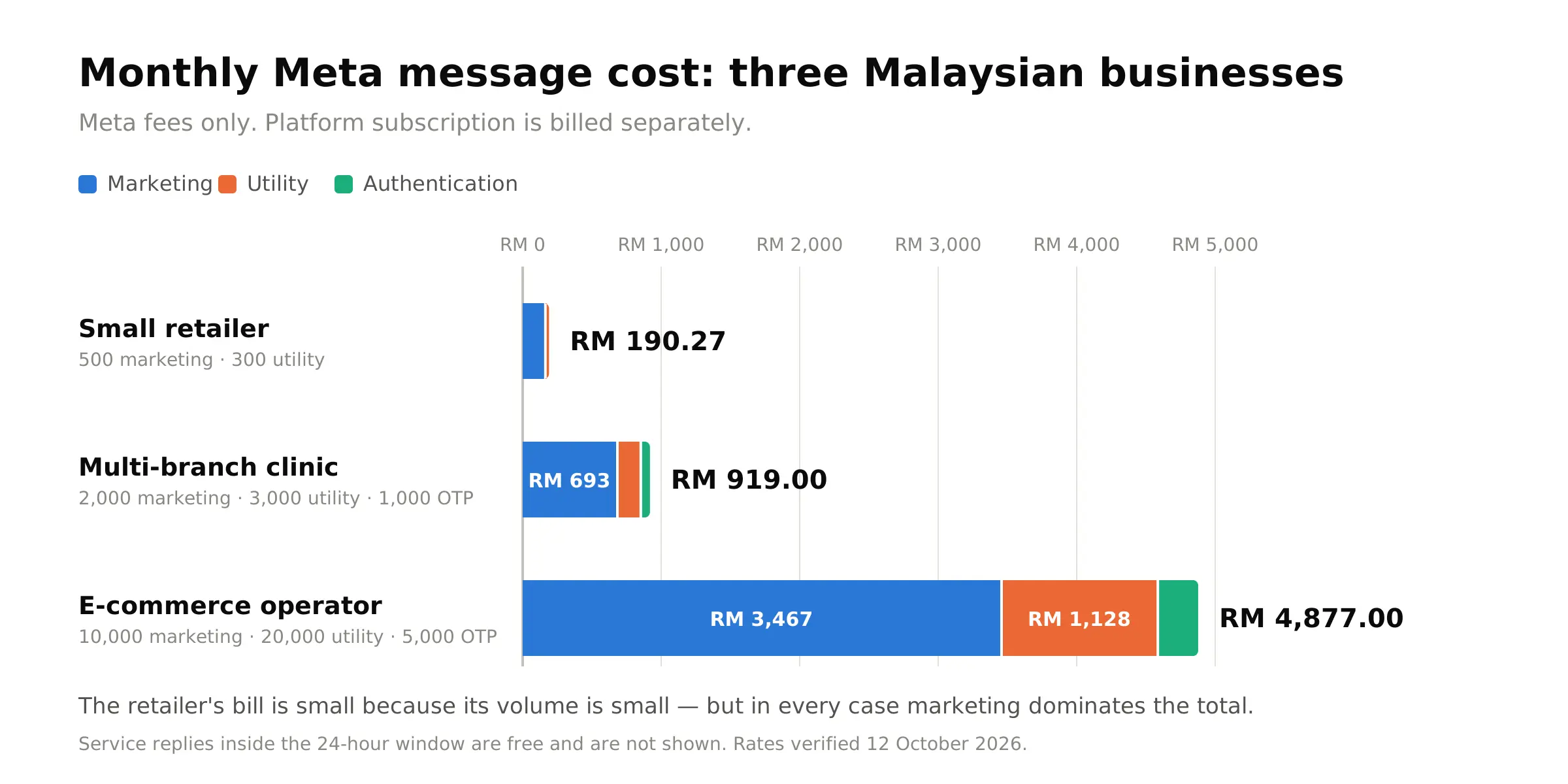
Meta message fees only. Platform subscription is separate.A small retailer
Two promotional campaigns a month, order updates sent after the conversation window closes, and ordinary support replies.| Item | Volume | Rate | Cost |
|---|---|---|---|
| Marketing templates | 500 | RM 0.3467 | RM 173.35 |
| Utility templates | 300 | RM 0.0564 | RM 16.92 |
| Service replies | ~2,000 | Free | RM 0.00 |
| Monthly Meta cost | RM 190.27 |
Note what dominates: 500 marketing messages cost ten times more than 300 utility messages.
A multi-branch clinic
Promotions, appointment reminders, and OTPs for the booking portal.| Item | Volume | Rate | Cost |
|---|---|---|---|
| Marketing templates | 2,000 | RM 0.3467 | RM 693.40 |
| Utility templates (reminders) | 3,000 | RM 0.0564 | RM 169.20 |
| Authentication templates | 1,000 | RM 0.0564 | RM 56.40 |
| Service replies | ~8,000 | Free | RM 0.00 |
| Monthly Meta cost | RM 919.00 |
Three thousand appointment reminders cost less than a quarter of what two thousand promotional messages cost.
A high-volume e-commerce operator
| Item | Volume | Rate | Cost |
|---|---|---|---|
| Marketing templates | 10,000 | RM 0.3467 | RM 3,467.00 |
| Utility templates | 20,000 | RM 0.0564 | RM 1,128.00 |
| Authentication templates | 5,000 | RM 0.0564 | RM 282.00 |
| Service replies | ~40,000 | Free | RM 0.00 |
| Monthly Meta cost | RM 4,877.00 |
At this volume, utility and authentication rates drop further through Meta’s volume tiers, so the real figure lands below this. Tiers are aggregated across your whole business portfolio and reset every month.
Six legitimate ways to cut the bill
None of these involve gaming Meta’s system. All of them are ordinary good practice.Send utility instead of marketing wherever the message genuinely is utility
This is the biggest lever available to you. Utility costs about 84% less than marketing in Malaysia. An order confirmation, a delivery update, an appointment reminder and a payment receipt are all genuinely utility messages — but they get rejected into the marketing category when businesses staple a promotion onto them.Use Click-to-WhatsApp ads properly
This one is badly underused. When a customer messages you through a Click to WhatsApp ad or a Facebook Page call-to-action button, and you reply, a 72-hour free entry point window opens. Inside that window, every message you send is free — including template messages.One important limitation most articles miss: this only applies when the customer taps through on the Android or iOS app. Desktop and web do not trigger it.If you are already running Meta ads, routing them to WhatsApp instead of a landing page can make three days of follow-up messaging free.Resolve inside the 24-hour window
Free-form replies within an open customer service window cost nothing. Every conversation your team closes inside that window is a conversation you did not have to reopen later with a paid template.This is the strongest financial argument for a proper shared inbox and an AI chatbot connected to your live data: faster first response and faster resolution mean more conversations finish while they are still free.Send one good template, not three mediocre ones
Per-message billing means a three-part campaign costs three times a one-part campaign. Many businesses split a message that should have been one. Write one template with a clear call to action and an interactive button.Clean your contact list
You pay for delivered messages. Broadcasting to a list full of dead numbers and people who never engage burns ringgit at the marketing rate for nothing. Segment by engagement and send to the people who actually open.Watch the recipient-country mix
If a meaningful share of your list sits on Singapore, Indonesian or European numbers, your blended rate is not the Malaysia rate. Segment your campaign reporting by country code so you can see where the money is actually going.What a platform costs on top
Meta’s fees are only the message layer. The API has no inbox, no chatbot, no ticketing and no reporting of its own — it is infrastructure. You also need software.Platform pricing typically covers: the shared team inbox, agent seats, AI chatbot, broadcast and campaign tools, ticketing, CRM, analytics and integrations. WaaPY’s plans are published here, and message fees from Meta are billed separately rather than marked up inside the subscription.When comparing providers, three questions separate the honest quotes from the rest:- Are Meta’s message fees marked up, or passed through at cost?
- Is there a per-agent charge, and what happens when the team grows?
- Are AI chatbot messages metered separately, and at what rate?
