
How an AI call in seconds, followed by a WhatsApp chatbot, turns Facebook and TikTok lead ads into booked viewings — without a negotiator picking up the phone until the buyer walks into the sales gallery.
A typical Monday for a property agency in the Klang Valley: the weekend’s ads did their job. There are new leads from Facebook, a few more from TikTok, and the team is pleased.
Then you look closer. Ahmad came in two minutes ago. Siti eighteen minutes ago. Daniel three hours ago — not called yet. Mei Ling yesterday — not called yet.
Nobody was lazy. The negotiators were at viewings, on the road, or asleep when the forms came in. But the buyer who filled in your form on Saturday night also filled in two other agencies’ forms. Whoever calls first usually gets the conversation.
This article walks through a different setup: an AI agent that calls every lead within seconds of the form, asks two qualifying questions, and hands the buyer to a WhatsApp chatbot that sends the price list and books the viewing into a human agent’s calendar.
In this guide
The short answer
- Lead response time is the cheapest conversion lever you have. Leads go cold within hours, and most businesses take far longer than that to call.
- An AI call closes the gap to seconds — at 11 pm, on Sunday, during a public holiday.
- The call does only two things: confirms the lead is real and asks the questions that decide whether this buyer is worth a negotiator’s time (own stay or investment, budget, timeline).
- WhatsApp does the rest: price list PDF, answers to specific questions, viewing slots, confirmation and reminders.
- The human negotiator meets a qualified, booked buyer — with the call and chat notes already in the calendar invite.
Why property leads go cold so fast
The best-known study on this is “The Short Life of Online Sales Leads”, published in Harvard Business Review in March 2011 by Oldroyd, McElheran and Elkington. Two findings still hold up:
- Speed wins. Across 1.25 million leads at 42 companies, firms that tried to contact a lead within an hour were nearly 7 times as likely to qualify it as firms that waited even one hour longer — and more than 60 times as likely as firms that waited 24 hours or more.
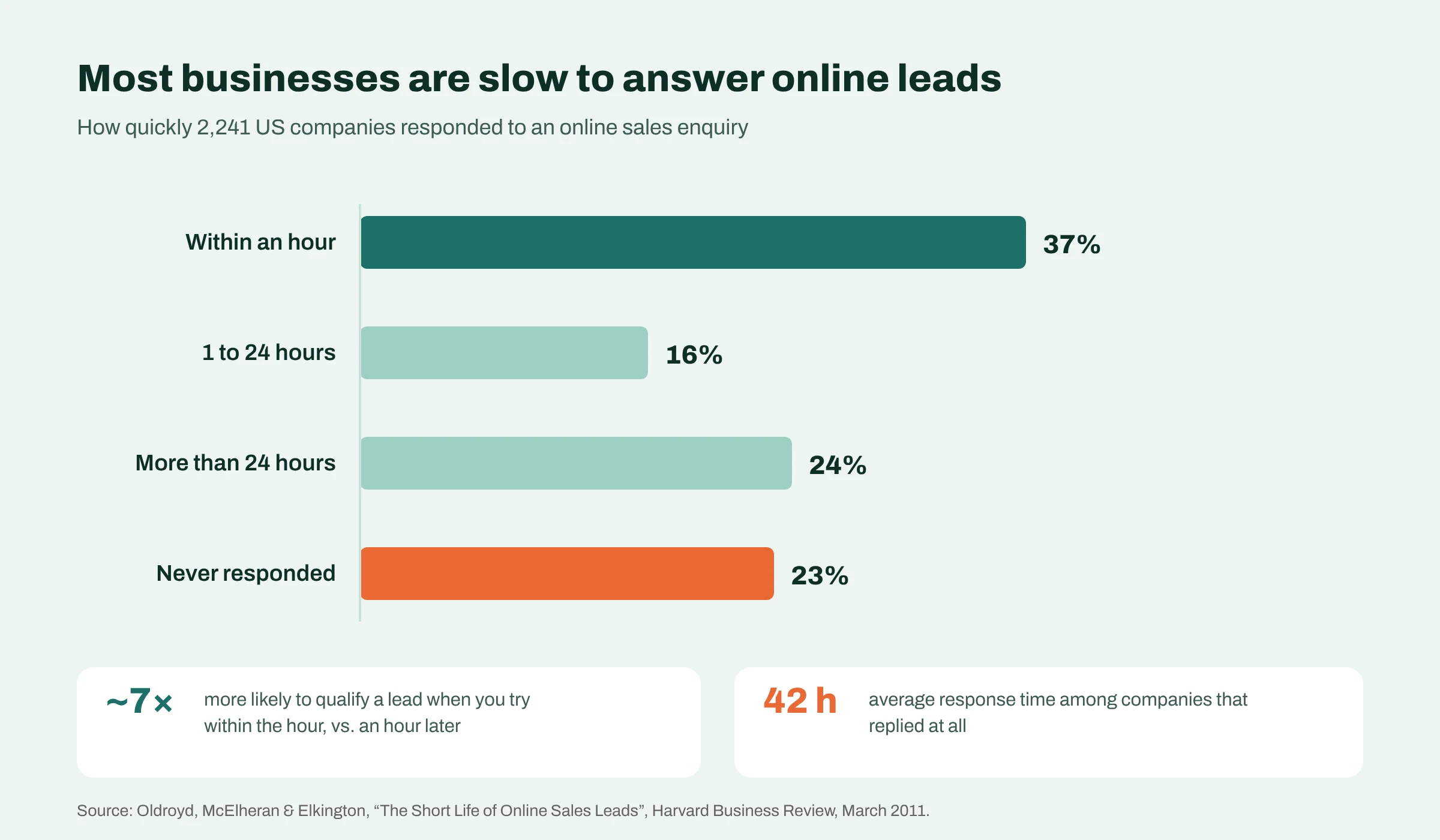
- Most businesses are slow. In an audit of 2,241 US companies, only 37% responded within an hour. 16% took one to 24 hours, 24% took more than a day, and 23% never responded at all. The average response time, among those that did respond, was 42 hours.
The study is from the US and it is fifteen years old. But if anything, buyer behaviour has moved in the same direction since: more forms per buyer, more agencies advertising the same project, shorter attention spans on social media.
Property has three extra problems that make slow follow-up worse:
Leads arrive when negotiators can’t call
Facebook and TikTok lead ads peak in the evening and at weekends — exactly when your team is conducting viewings or off duty.
Buyers shop several agencies at once
One buyer, one Saturday night, three forms. The first agency to call frames the conversation; the others become “I already spoke to someone.”
Ad money is spent up front
You pay for the lead whether or not anyone calls it. Every uncalled lead is ad spend thrown away.
The setup, step by step
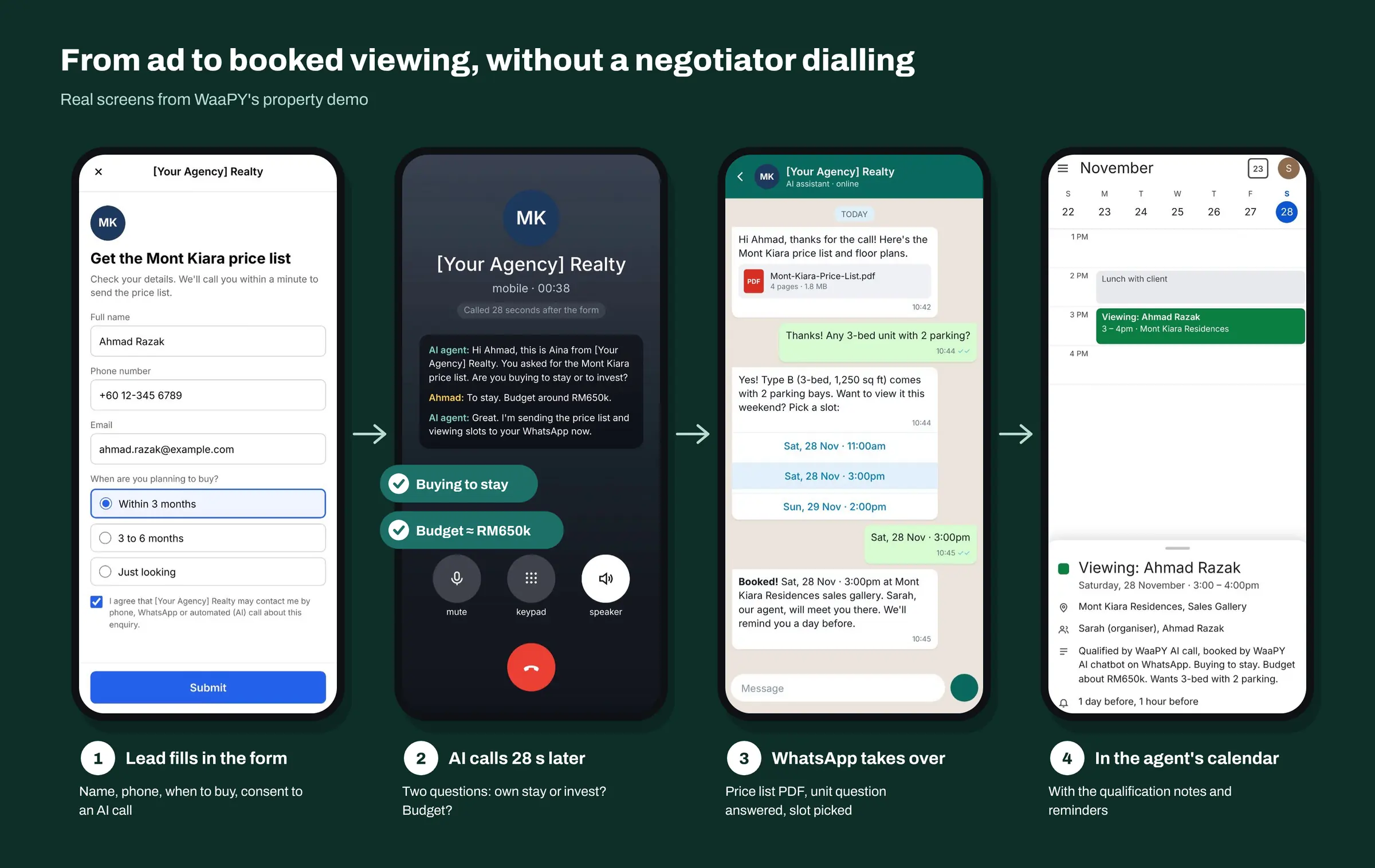
This is the flow shown in WaaPY’s property demo. The agency, project and buyer are placeholders.
Step 1
The buyer sees your ad and fills in the form
A buyer sees a sponsored post for new 3-bedroom condos in Mont Kiara and taps Sign up. The instant form asks for name, phone, email and one qualifying question — When are you planning to buy? (within 3 months / 3 to 6 months / just looking).
Two details on that form matter more than they look:
- The promise. “We’ll call you within a minute to send the price list.” The buyer is expecting the call, so it doesn’t feel like a cold call.
- The consent line. A checkbox: “I agree that [Your Agency] Realty may contact me by phone, WhatsApp or automated (AI) call about this enquiry.” Naming the AI call up front is honest, and it is your record of consent. More on this below.
Step 2
The AI calls within seconds
In the demo, the call connects 28 seconds after the form is submitted. The AI agent introduces herself by name and agency, reminds the buyer why she’s calling, and asks one question:
AI agent: Hi Ahmad, this is Aina from [Your Agency] Realty. You asked for the Mont Kiara price list. Are you buying to stay or to invest?
Ahmad: To stay. Budget around RM650k.
AI agent: Great. I’m sending the price list and viewing slots to your WhatsApp now.
Under 40 seconds, and the call has done its job: the lead is real, reachable, buying for own stay, with a budget around RM650k and a 3-month timeline from the form. That is a lead worth a negotiator’s Saturday.
Notice what the AI doesn’t do on the call: read out prices, list unit types or push for a decision. Voice is good for attention and quick answers. It is bad for numbers, floor plans and dates — which is why the next step moves to WhatsApp.
Step 3
The WhatsApp chatbot takes over
Seconds after the call ends, the buyer has a WhatsApp message from the agency with the Mont Kiara price list PDF attached.
The buyer asks what buyers actually ask: “Any 3-bed unit with 2 parking?” The chatbot answers from the project’s data — Type B, 3-bed, 1,250 sq ft, comes with 2 parking bays — and immediately offers three viewing slots:
- Sat, 28 Nov · 11:00am
- Sat, 28 Nov · 3:00pm
- Sun, 29 Nov · 2:00pm
The buyer taps Sat 3:00pm. The chatbot confirms the booking, names the negotiator who will meet them at the sales gallery, and says it will send a reminder a day before.
Step 4
The viewing lands in the agent’s calendar
The negotiator — Sarah, in the demo — sees a new event appear: Viewing: Ahmad Razak, Saturday 28 November, 3:00–4:00 pm, Mont Kiara Residences sales gallery. The invite includes both parties, reminders one day and one hour before, and the notes that matter:
Qualified by WaaPY AI call, booked by AI chatbot on WhatsApp. Buying to stay. Budget about RM650k. Wants 3-bed with 2 parking.
Sarah hasn’t spoken to Ahmad yet. When she does, she already knows what to show him.
Why a call and WhatsApp, not one or the other
You could do this with only a chatbot, or only a calling team. Both leave money on the table.
| Call only | WhatsApp only | AI call → WhatsApp | |
|---|---|---|---|
| Gets attention in the first minute | ✓ | ! Easy to ignore | ✓ |
| Confirms the lead is real and reachable | ✓ | ✕ | ✓ |
| Sends price list, floor plans, location pin | ✕ | ✓ | ✓ |
| Lets the buyer pick a slot at their own pace | ✕ | ✓ | ✓ |
| Leaves a written record the buyer can scroll back to | ✕ | ✓ | ✓ |
| Works at 11 pm on a Sunday | ✕ Not with humans | ✓ | ✓ |
The call earns the reply. WhatsApp carries everything that is hard to say out loud.
What the AI should ask on the first call (and what it shouldn’t)
The first call is not a sales pitch. Keep it under a minute and ask only what changes what happens next.
✓ Ask
- Own stay or investment? It changes which units, which negotiator and which follow-up content.
- Rough budget. One number is enough. Don’t push for a range.
- Confirm the timeline if the form didn’t ask it.
- Permission to continue on WhatsApp. “I’m sending the price list to your WhatsApp now” sets it up naturally.
✕ Don’t
- Read out prices, unit sizes or promotions. That belongs in writing.
- Ask about income, loan eligibility or other personal finances on a first call. Leave that for a human at the right stage.
- Try to close. The goal of the call is a booked viewing, not a booking fee.
Consent and the PDPA: do this properly
An AI calling people sounds risky. In practice, the rules are the same as for a human calling people, and Malaysia’s Personal Data Protection Act 2010 (PDPA) is clear about the basics:
- Get consent before you call. The PDPA’s General Principle (Section 6) requires consent before processing someone’s personal data. A lead form with a clear consent line covers this enquiry.
- Say what kind of contact to expect. Naming “phone, WhatsApp or automated (AI) call” on the form, as the demo does, removes any surprise.
- Honour opt-outs fast. Under Section 43, a person can tell you to stop using their data for direct marketing. If a lead says “don’t call me again” on the call or in WhatsApp, stop — and make sure that applies everywhere, not only in one tool.
- Keep records. Store the form submission, the consent text and the call outcome against the lead.
This is general guidance, not legal advice. If you run large campaigns, have your consent wording checked.
What to measure
You don’t need a dashboard of twenty numbers. Track these five, weekly, before and after you switch on AI calling:
- Time to first contact — from form submission to first call attempt.
- Contact rate — leads who actually answered or replied.
- Viewings booked per 100 leads.
- Show-up rate — booked viewings that actually happened.
- Ad cost per viewing, not just cost per lead.
The number that matters
The last one is the number your agency principal cares about. Cheaper leads that nobody calls are not cheaper.
Where the human negotiator comes in
AI calling doesn’t replace negotiators. It removes the part of their week they hate most — dialling numbers that don’t pick up, and calling leads who were never going to buy — and leaves them the part only they can do: the viewing, the negotiation and the relationship.
A practical split:
| AI handles | Negotiator handles |
|---|---|
| First call within seconds, 24/7 | The viewing itself |
| Price list, floor plans, location | Negotiation, discounts, loan referrals |
| Answering standard unit questions | Questions that need judgement |
| Booking, confirmation, reminders | Follow-up after the viewing |
| Notes in the calendar invite | Closing |
If a buyer on the call asks for a person, or the conversation goes somewhere the AI shouldn’t, it should hand over — with notes — rather than improvise.
How WaaPY does this
WaaPY connects the pieces in one place:
1
AI calls every lead in seconds
Triggered by your lead form, at any hour.
2
AI chatbot books on WhatsApp
Sends documents, answers project questions from your data, offers slots and confirms.
3
Synced to your agent’s calendar
With the qualification notes and reminders already in the invite.
✓
No staff needed until the viewing
Your negotiators meet buyers who are qualified, booked and expecting them.
Book a free 20-minute demo → We’ll walk through the flow using one of your own projects.
Sources
Oldroyd, McElheran & Elkington, “The Short Life of Online Sales Leads”, Harvard Business Review, March 2011 · Personal Data Protection Act 2010 (Act 709), Sections 6 and 43
Related reading
