
Last verified against Telegram and Meta’s published documentation: 27 October 2026
The honest answer is that this is usually the wrong question.
The short version
Telegram and the WhatsApp Business API are not competitors fighting for the same job. One gives you reach — almost everyone in Malaysia already has WhatsApp installed, and you can message any customer who has opted in. The other gives you freedom — no messaging window, no template approval queue, no per-message fee, but only with people who have already started your bot.
Most businesses that ask “which one” end up running both. This guide explains how to decide which does which job for you, with real numbers on both sides and the limits that neither side’s marketing mentions.
In this guide
The fundamental trade-off
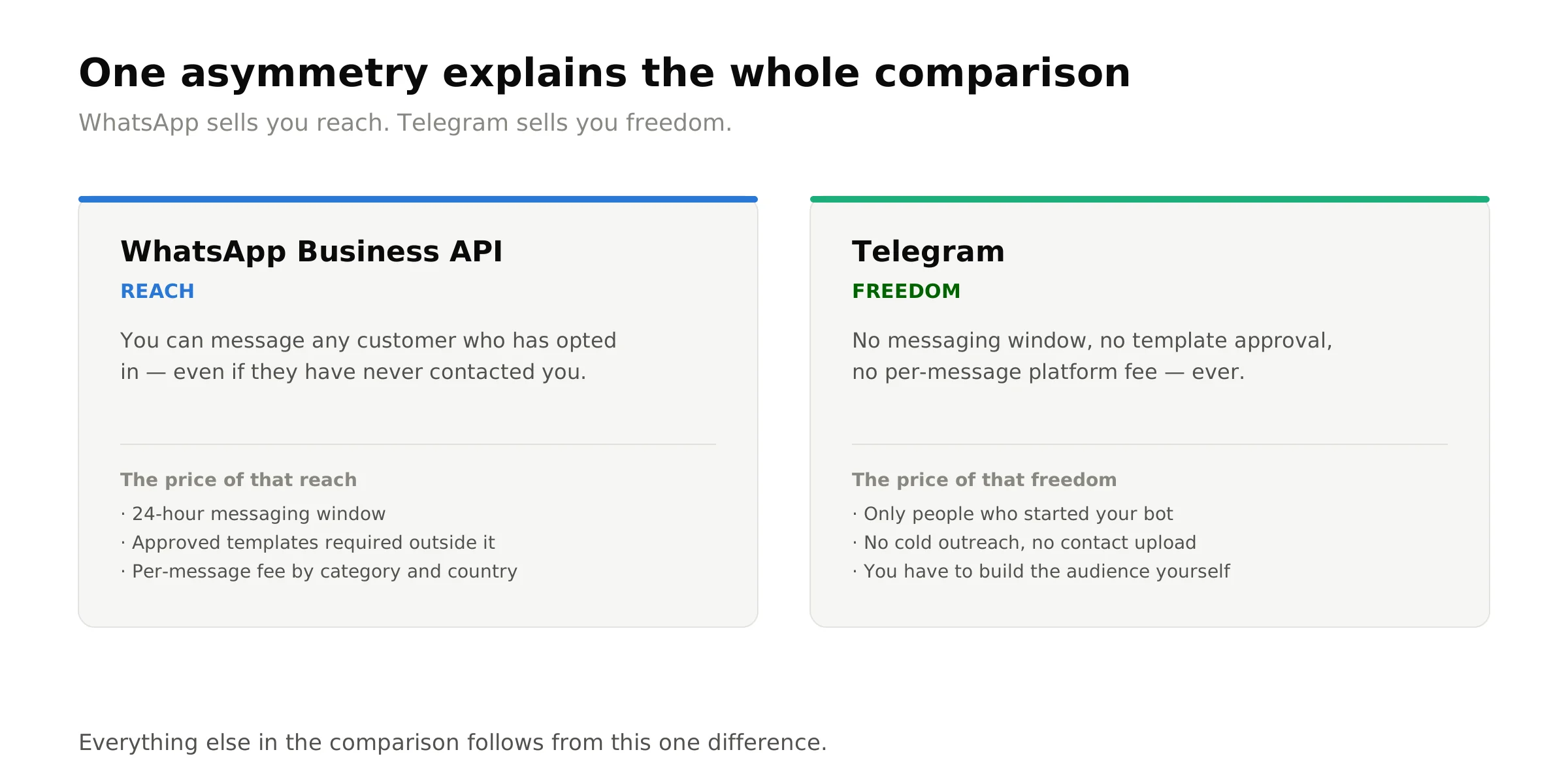
Strip away the feature lists and the difference comes down to one thing:
WhatsApp Business API
Reaches people who have not contacted you yet
If a customer has given you their number and consented, you can send them an approved template message. That is enormous. It is also why Meta charges for it and governs it tightly.
Telegram
Only talks to people who started your bot
No cold outreach, no uploading a contact list, no workaround. In exchange, once someone has started your bot, Telegram gets out of the way almost entirely — no 24-hour window, no template approval, no per-message platform fee.
Everything else in this comparison follows from that single asymmetry.
The full comparison
| Feature | Telegram | WhatsApp Business API |
|---|---|---|
| Who you can message | Only people who have started your bot | Any customer who has opted in |
| Messaging window | None | 24 hours from the customer’s last message |
| Outbound after the window | Allowed, any time, no template | Approved template message required |
| Template approval | ✓ Not required | Required, and templates get rejected |
| Per-message platform fee | None by default | Per delivered template, by category and country |
| Broadcast speed | About 30 messages per second | Governed by your messaging tier |
| Audience size in Malaysia | A minority of consumers | Near-universal |
| Interactive UI | Inline keyboards, menus, mini-apps | Buttons, lists, flows |
| File handling | Large files and documents natively | Size-limited |
| Groups and channels | ✓ Core to the platform | Limited |
| Voice calling | ✓ Native | ✓ Through the Business Calling API |
| Setup effort | Create a bot, minutes | Business verification, number registration |
| Best at | Communities, power users, updates, support, fee-free follow-up | Mainstream reach, transactional notifications, mass campaigns |
Where WhatsApp wins
Reach, and it is not close
In Malaysia, WhatsApp is effectively the default messaging app. Telegram has a real and growing user base, but it skews toward specific communities — crypto and fintech, tech-literate users, certain diaspora groups — rather than the general consumer population. If you need to reach a broad Malaysian customer base, Telegram cannot do it.
Cold-start outreach
You can message a customer who gave you their number at the point of sale, three weeks later, with an approved template. On Telegram that is impossible unless they have already found and started your bot.
Transactional notifications that must arrive
Order confirmations, delivery updates, OTPs and appointment reminders go to the number the customer already gave you. The delivery rate on a channel everyone has installed is simply higher.
Click-to-WhatsApp advertising
Meta’s ad ecosystem routes directly into WhatsApp conversations, with an extended free messaging window attached. Telegram has no equivalent integration with Meta’s ad platform.
Where Telegram wins
No messaging window
This is the one that changes how you operate. On WhatsApp, if a customer messaged you twenty-five hours ago, you need an approved template to follow up. On Telegram, you just send the message. Sales follow-ups, “your item is back in stock”, “here’s the quote you asked about last week” — all free-form, any time.
No template approval
No review queue, no rejections, no waiting two days to send a campaign that is time-sensitive today.
No per-message platform fee
By default, bots message their users at no cost. For a business sending large volumes of updates to an opted-in audience, this is the difference between a four-figure monthly bill and nothing.
Files, groups and channels
Price lists, catalogues, PDFs, large video. Support communities, VIP groups, announcement channels. All native, all without the file-size headaches.
Richer interactive UI
Inline keyboards, persistent menus and mini-apps give you considerably more room than a text bubble with three buttons.
The cost comparison, with real numbers
Here is the same campaign on both channels — 10,000 marketing messages to Malaysian customers.
| Campaign | Telegram | WhatsApp Business API |
|---|---|---|
| 10,000 marketing messages | RM 0 | RM 3,467 |
| Rate per message | No platform fee | RM 0.3467 (Malaysia marketing rate) |
| Who receives it | Only bot subscribers | Any opted-in contact |
| Time to send | About 5–6 minutes | Governed by your tier |
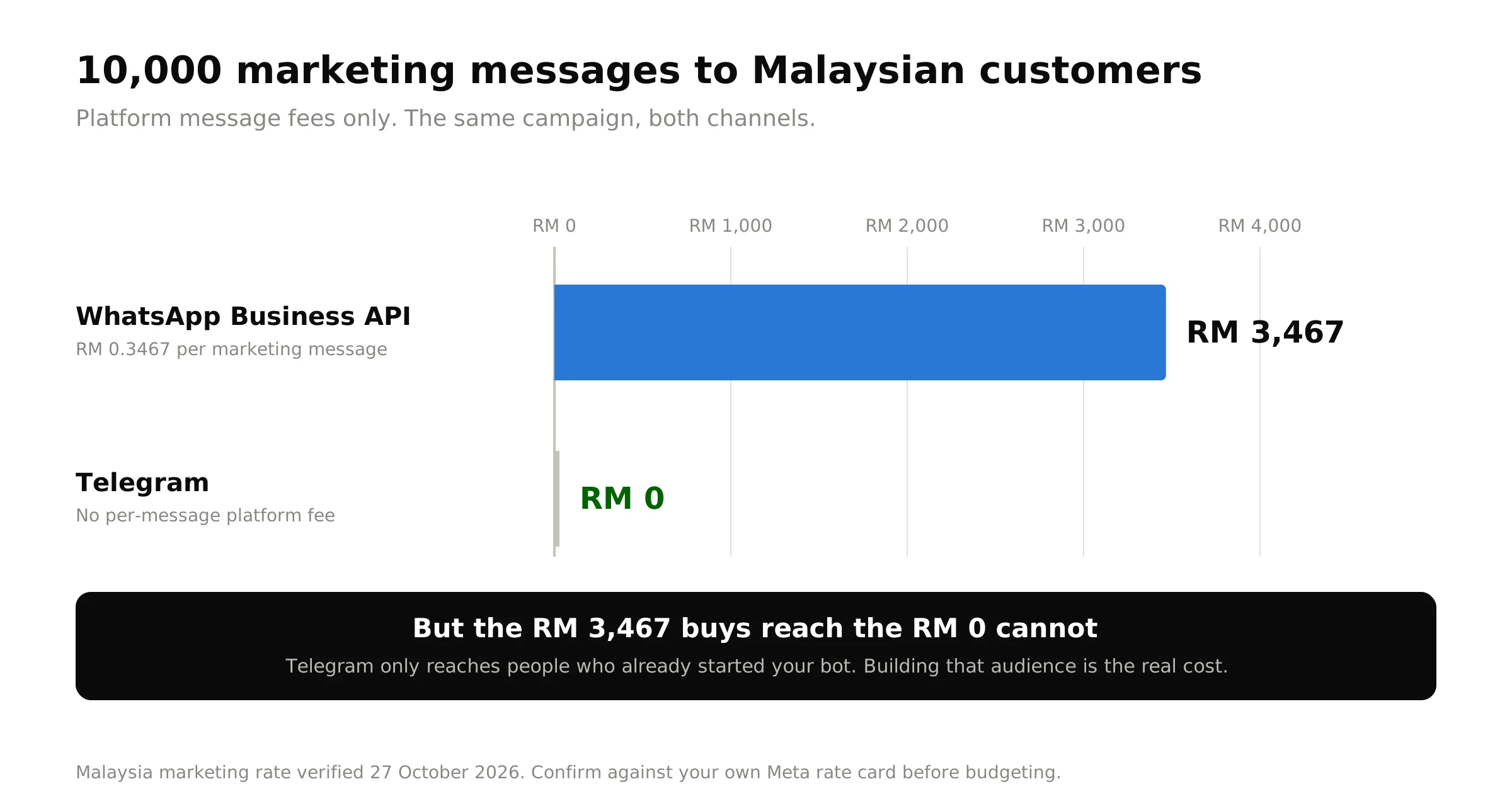
That gap is real, and it is the single strongest argument for Telegram.
It is also incomplete, and any article that stops here is selling you something. The RM 3,467 buys reach that the RM 0 cannot. If your 10,000 WhatsApp contacts are customers who gave you their number, and your Telegram audience is 400 people who found your bot, the cheaper channel is not the better one. It is just cheaper.
The honest framing
Telegram is free for the audience you have already built on Telegram. Building that audience is the work, and it is not free.
For the full WhatsApp cost picture — all four message categories, three worked monthly examples, and six ways to cut the bill — see our WhatsApp Business API pricing breakdown for Malaysia.
Two limits nobody mentions
1. Telegram’s bot-start wall
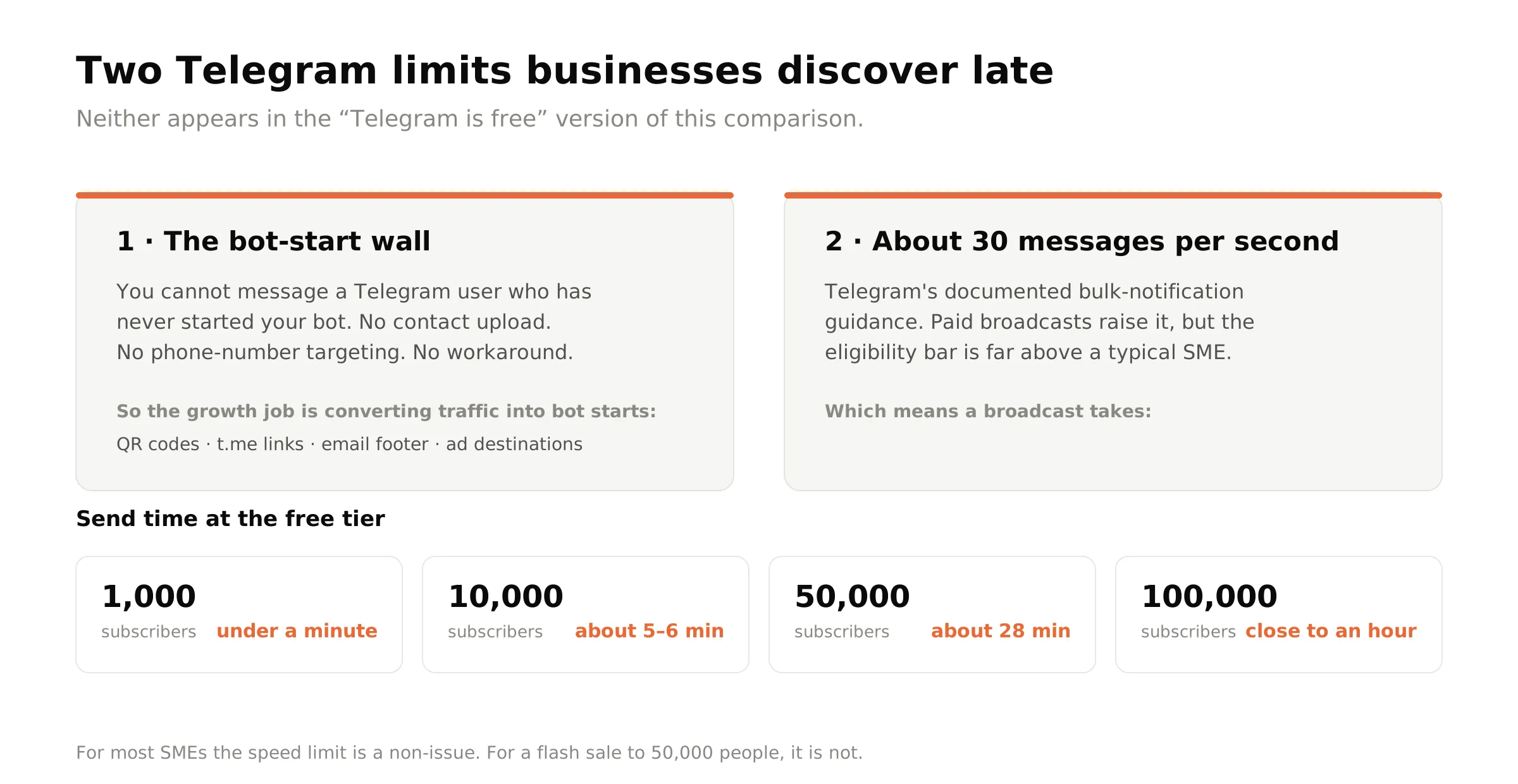
Worth repeating because it is the thing businesses discover after they have built the bot: you cannot message a Telegram user who has never started your bot. No contact upload, no phone-number targeting, no workaround.
So the entire growth problem on Telegram is converting existing traffic into bot starts:
- QR codes on packaging, receipts and in-store signage
- A t.me link in your email footer and on your website
- A link in your WhatsApp auto-reply, pointing customers to the fee-free channel
- Ad campaigns with the bot as the destination
- A deep link carrying a campaign parameter, so you know which source brought each subscriber
That work is the real cost of Telegram. It is usually worth doing. It is never free.
2. Telegram’s broadcast speed limit
The other one that surprises people at scale. Telegram’s documented guidance is that bots cannot broadcast more than about 30 messages per second. In practice:
| Audience size | Approximate send time at 30/sec |
|---|---|
| 1,000 subscribers | Under a minute |
| 10,000 subscribers | About 5–6 minutes |
| 50,000 subscribers | About 28 minutes |
| 100,000 subscribers | Close to an hour |
For most SMEs this is a non-issue. For a flash sale going to 50,000 people where the first and last recipient are half an hour apart, it matters.
Telegram does offer paid broadcasts that raise the ceiling to around 1,000 messages per second, charged in Telegram Stars — but eligibility requires a very large Stars balance and a very large monthly active user base. It is not a route a typical SME will qualify for, and the free tier is where realistic planning should sit.
The actual recommendation: run both
For most businesses the productive question is not “which” but “which job”.
1
WhatsApp does acquisition and transactions
It is where you reach customers who have not opted into anything yet, where your order and delivery notifications land, and where your paid ad traffic converts. You accept the per-message cost because it buys reach you cannot get elsewhere.
2
Telegram does retention and depth
It is where your engaged customers, community members and repeat buyers live, where follow-up costs nothing, and where no window closes on a conversation. You accept the smaller audience because the economics inside it are unbeatable.
The bridge most businesses never build
Put a t.me link in your WhatsApp auto-reply. Customers who are already talking to you on the expensive channel get invited to the free one. Over months, your most engaged customers migrate to the channel where talking to them is free, and your WhatsApp spend concentrates on the people you cannot reach any other way.
That only works if both channels sit in one system, with one contact record. Running them as two disconnected tools means the same customer is two strangers, and you have no way to know who migrated. WaaPY runs WhatsApp and Telegram in the same inbox, with the same AI chatbot, ticketing, CRM and reporting across both.
So — which should you use?
A straight answer, by situation:
| Your situation | Recommendation |
|---|---|
| Malaysian SME serving general consumers | WhatsApp first. Telegram’s audience is not where your customers are yet. |
| Crypto, fintech, SaaS or a tech-literate audience | Telegram first. Your customers already live there, and the economics are better. |
| Heavy transactional notification volume | WhatsApp, using utility templates rather than marketing. |
| Large engaged community or membership base | Telegram. Groups, channels and fee-free follow-up are built for this. |
| Running Meta ads at meaningful spend | WhatsApp. The ad integration and free entry window have no Telegram equivalent. |
| Follow-up conversations keep dying at the 24-hour window | Add Telegram for the customers willing to move, and keep WhatsApp for the rest. |
| Serving customers across several countries | Both, plus check the local default — LINE in Japan, Thailand and Taiwan, not Telegram or WhatsApp. |
Working out your own answer
If your customers are mainstream Malaysian consumers, start with WhatsApp and treat Telegram as a retention layer you build deliberately over time. If your customers are a technical or community-driven audience, the reverse is probably true.
If you are not sure which describes you, that is usually answerable in one conversation — we can look at where your enquiries currently come from and tell you honestly which channel deserves the investment first.
Related reading
